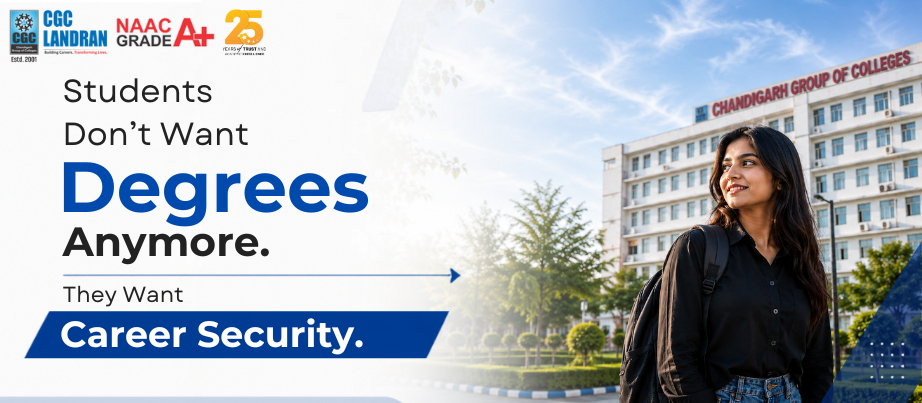
Here's a question no one used to ask their college counsellor: "What happens to my degree if AI replaces my job in five years?"
Today, it's one of the first things Gen Z students think about. Not because they're pessimistic but because they're paying attention. They've watched industries shift in real time, seen "safe" career paths quietly disappear, and grown up knowing that the world they graduate into may look nothing like the one they entered.
So the question students are really asking when they choose a college in 2025 isn't "which degree should I pick?" It's: "Will this place actually prepare me for what's coming?"
That's a fundamentally different standard, and most colleges haven't caught up to it yet.
The Degree Isn't Dead. But It's No Longer Enough.
Let's be clear: a degree still matters, employers still ask for it, and graduate salaries are still higher on average. The credential isn't going anywhere, but here's what's changed! The degree used to be the whole answer. Now it's just the opening line.
Walk into most interviews today, and your marksheet only gets a glance. However, what gets the real scrutiny is everything else: What have you built? What can you actually do? How do you think when a problem doesn't have a textbook answer?
According to the 2024 LinkedIn Workforce Report, skill-based hiring has grown significantly across sectors, with employers increasingly listing competencies rather than degrees as primary requirements in job postings. Companies like Google, Apple, IBM, and Tesla have already dropped degree requirements for many roles. What they want instead: demonstrated ability, technical fluency, and the capacity to learn fast.
For students sitting in college right now, this means your CGPA is one data point among many. And the students landing the best opportunities are the ones who graduate with a degree and a portfolio — certifications, internship experience, real projects, proof that they can function outside a classroom.
The goal has quietly shifted from graduation to employability.
What AI Is Actually Doing to the Job Market (And Why Students Feel It)
“Artificial Intelligence is the defining professional anxiety of this generation, and it's worth being honest about what it is and isn't doing.”
In simple words, AI is shaping how people think about careers and jobs.
Students, employees, and professionals often ask questions like:
- “Will AI take my job?”
- “Is my degree still valuable?”
- “Which skills will still matter?”
- “How do I stay relevant?”
“Thus, we should talk about AI realistically, not emotionally or dramatically.”
AI is changing work:
- automating repetitive tasks
- helping with writing, coding, design, and analysis
- increasing productivity
- changing hiring expectations toward skills and adaptability
But AI isn’t:
- instantly replacing all professionals
- eliminating the need for human judgment, creativity, leadership, empathy, and problem-solving
- making degrees useless overnight
“All in all, we should understand AI realistically — neither panic nor ignore it.”
So, we can conclude that the real threat isn't AI! It is staying average in a world where AI is raising the bar for everyone. Skilled professionals who continuously learn and adapt will remain in demand.
Tasks that used to require a junior employee, like data entry, basic report generation, template-based design, routine customer queries — are now being automated. That's not catastrophic, but it does mean entry-level roles are changing faster than ever. The jobs that survive are those that require judgment, creativity, communication, and the ability to use AI as a tool rather than compete with it.
The students who'll thrive in this environment aren't the ones who avoid AI. They're the ones who understand it well enough to direct it, question it, and build on top of it.
This is why students today are actively looking for colleges that expose them to emerging technologies, and not as electives or optional add-ons, but as core parts of their education. Students want to graduate with industry-ready skills, not start learning from scratch after getting a job.
The Shift to Skill-First Hiring: What Employers Are Actually Looking For
Ask a recruiter at any major tech or consulting firm what they're evaluating in a candidate, and you'll hear a strikingly consistent list:
Technical ability — Can you solve problems using the right tools? Do you understand systems, not just concepts?
Project experience — Have you shipped anything? Built anything? Delivered something under real constraints?
Communication — Can you explain complex ideas clearly? Can you work across teams, functions, and levels?
Adaptability — Do you learn quickly? Do you stay functional when things change?
Digital literacy — Are you comfortable navigating new platforms, tools, and workflows as they emerge?
A degree signals that you completed a structured program, and these qualities signal that you're actually ready to work. And the best colleges make sure their students graduate with both!
What "Future-Ready" Actually Looks Like in Practice
Students are increasingly sharp at detecting the gap between what colleges promise and what they deliver. A college cannot call itself industry-focused if it is teaching the same outdated curriculum it taught years ago.
Here's what genuinely future-ready education actually looks like in practice and what you should be asking about when you evaluate any institution:
Emerging technology in the curriculum, not as an afterthought. AI, Data Science, Cybersecurity, Robotics, IoT — these shouldn't be electives available to a handful of students. They should be woven into the academic fabric, available across branches, and taught using current tools by faculty who actually engage with the industry.
Practical learning that goes beyond the lab manual. Hackathons, live industry projects, innovation challenges, and research opportunities aren't extracurricular nice-to-haves. They're where students learn to function under real conditions: incomplete information, tight deadlines, teams that don't always agree. That experience is what differentiates a graduate who can perform from one who can only describe.
Internships that are real, not ceremonial. An internship pipeline that connects students to real companies where they take on real responsibilities, get feedback, and, ideally, build toward a pre-placement offer is worth more than almost anything else a college can offer. Ask specifically: how many students secure internships? In which semester? With which companies? What percentage convert to full-time roles?
An entrepreneurial ecosystem that's genuinely functional. For students who want to build rather than be employed, this matters enormously. A college must offer not just an incubation centre that exists only on a brochure, but one with active mentorship, access to funding, and a track record of student ventures that actually launch.
Placement preparation that starts early. The students who perform best in campus recruitment aren't the ones who start preparing in their final year. They're the ones whose colleges built aptitude training, mock interviews, communication skills, and industry interaction into the program from semester three onwards.
The Entrepreneurship Shift: Not Everyone Wants a Job
Here's something that's changing faster than most colleges have realised: a meaningful portion of Gen Z doesn't want to be employed at all — at least not in the traditional sense.
They want to build things, create digital products, launch communities, and build businesses around skills they've developed. Today's generation has seen people in their early twenties build million-dollar businesses online, so traditional career paths don't seem as attractive.
This doesn't mean every student is going to found a startup, but it does mean that the option matters. Students are increasingly drawn to colleges that treat entrepreneurship as a legitimate outcome rather than a consolation prize for those who didn't get placed.
Today's ambitious students prefer colleges that help them turn ideas into reality through innovation labs, startup support, and guidance from industry experts.
The College Decision Is Now a Career Decision
Here's the frame shift that matters most.
For a long time, choosing a college was primarily an academic decision. Which institution has the best reputation? Which one did my relatives attend? Which one has the best rankings?
Today, students are making a different calculation. They're asking: which institution is going to give me the best chance of building the career I actually want? Not just the degree — the platform, the exposure, the network, the skills, the proof of work.
That's why factors like placement records, internship access, industry tie-ups, and technology infrastructure have moved from "nice to have" to "deal breaker" in how students evaluate options.
At CGC Landran, this approach is reflected in Centres of Excellence in emerging technologies, strong industry partnerships, support for innovation and entrepreneurship, and a placement-focused ecosystem with a 360-degree Pre-Placement Training Program (TPP) that helps students become career-ready before they graduate.
Overall, the philosophy is simple: a degree is the credential; everything else is what makes you ready.
What to Actually Ask When Evaluating a College
If you're a student (or a parent helping one decide), here are the questions worth asking — not the ones colleges are used to answering, but the ones that actually matter:
- What percentage of students secured internships last year, and in which semester?
- How many students from the most recent batch were placed, and at what average package?
- Which emerging technologies are part of the core curriculum — not electives?
- Does the college have an active startup incubation programme? How many ventures have launched from it?
- What does placement preparation look like, and when does it start?
- What industry certifications can students earn alongside their degree?
The answers to these questions will tell you far more than any brochure ranking.
Take Away
Career security in 2025 doesn't come from a degree; it comes from what you build alongside it.
The students who will thrive in the next decade are the ones who graduate with technical fluency, practical experience, a network they've actually earned, and the confidence that comes from having already done hard things.
The colleges that will matter are the ones that make that possible, not just in their marketing but in their classrooms, labs, placement cells, and culture.
So, choose accordingly; choose CGC Landran!